Last updated: October 2026
Quick answer
Commercial concrete is planned around loads, traffic, drainage, schedule and code. Albany Concrete pours commercial slabs, foundations, and barn, shop and equipment pads for businesses, farms and property owners in Albany, Salem, Corvallis, Lebanon and across Oregon. Tell us what will sit or drive on the slab and we will scope thickness, base and reinforcement accordingly. Free estimates: (503) 862-3881.
Start with the load and the use
The question that shapes every commercial slab is what it will carry. A retail floor, a shop with forklifts, a truck apron, a livestock barn and a warehouse dock all need different thicknesses, reinforcement, joints and finishes. We ask what will be parked, driven or stored on the slab, how heavy it is, whether wheels are hard or pneumatic, whether there will be point loads such as racking or lifts, and whether the surface will be washed, coated or left bare. Those answers guide thickness, subgrade treatment and steel.
Plans and engineering may specify these details for larger projects. On smaller jobs, without engineered plans, we describe the assumptions in writing so both sides agree on what the slab is designed to do.
Shop, barn and equipment pads
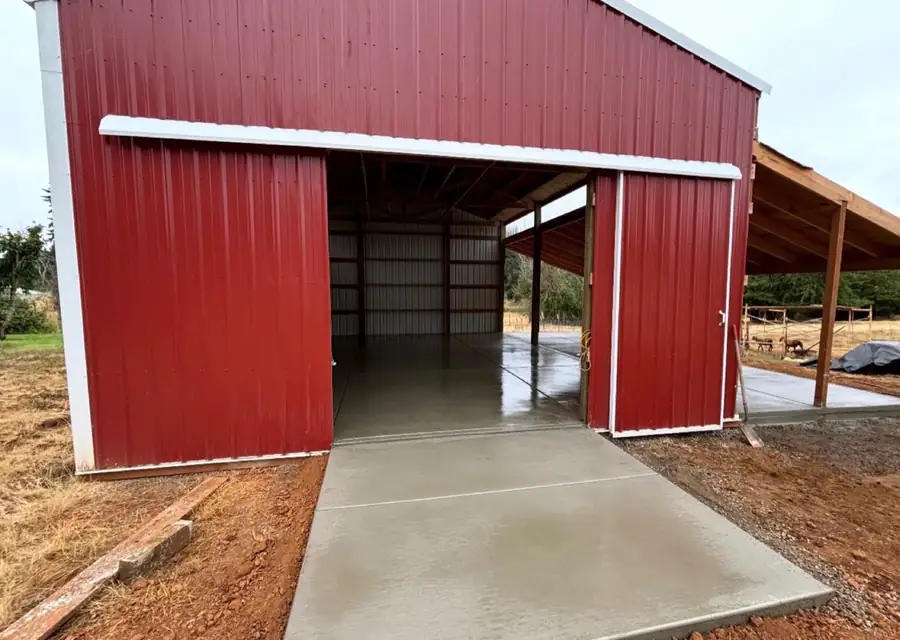
Agricultural and rural properties around Albany, Tangent, Shedd and Halsey often need shop floors, barn slabs, hay storage pads and equipment aprons. These slabs commonly need thickened edges, a vapor barrier under enclosed floors, drainage or floor slopes to a drain, and a durable finish. A shop floor that will see welding, oil and heavy jacks calls for a different approach than a stall floor that will be hosed down. We can discuss how a floor will be used and design around it, including sloping to drains and setting anchors for equipment.
Foundations and commercial slabs
Foundation and structural slab work should follow the approved plans and inspection requirements for your project. We coordinate with the builder or owner on the schedule, forms, rebar placement, embedded items and inspection points. Reinforcement is chaired off the ground rather than dropped into the dirt, and joints are laid out to match the structure. If plans are not yet drawn, we suggest bringing an engineer or designer in before pricing anything structural.
Subgrade, drainage and joints
Soft or wet subgrades cause more commercial slab failures than any other single factor. Valley-floor soils around Albany, Jefferson and Halsey often hold water in winter, so a proof-rolled, compacted rock base and a clear drainage path matter. Control and isolation joints are placed to match columns, walls and equipment, so the slab moves where it is designed to. Poor joint layout causes random cracking that owners mistake for bad concrete.
Finish, curing and downtime
Hard-trowel finishes are smooth and easy to sweep but can be slick when wet. Broom and light-texture finishes give traction outdoors and at entries. Curing protection reduces early cracking and dusting, and the slab should not see heavy loads until it has gained strength. For businesses that need to stay open, phasing the pour and giving a clear return-to-service date helps. We plan around your schedule as far as concrete chemistry allows.
Questions to ask any commercial concrete contractor
What thickness and reinforcement are priced, and who specified them? How will soft spots be handled? How are joints laid out relative to columns and racking? What is the curing plan and when can equipment use the slab? Who is responsible for permits and inspections? Clear written answers are worth more than a low lump sum. Our prep and warranty guide gives a checklist for comparing scopes, and the cost guide explains what drives price.
Repairs, replacement and partial demolition
Not every commercial job is a new slab. We are also asked about cutting out and replacing a failed section, extending an existing pad, or replacing a broken loading apron. Those jobs depend on why the original concrete failed, whether it was the base, drainage, a thin section or simple overload, and on how the new concrete will tie into the old. We look at the failure first and describe what would prevent a repeat, even when that costs more than a quick patch. Doweled joints, new rebar tied into existing steel and a properly compacted base at the patch line all help a repair last.
Frequently Asked Questions
Do you pour barn and shop floors?
Yes. We pour barn, shop and outbuilding slabs, and we discuss thickened edges, vapor barriers, drains and finish so the floor suits how it will be used.
Can you work from engineered plans?
Yes. When plans specify thickness, reinforcement and inspections, we build to them. When they do not exist, we describe our assumptions in writing.
Do you travel outside Albany for commercial work?
Yes. We serve Albany and the surrounding mid-Valley and travel across Oregon for commercial projects. Call to confirm your address.
Related services
Helpful guides
Ready to talk about your project? Call or text (503) 862-3881, Monday to Saturday, 7:00 AM to 8:00 PM, or use the free quote form.
Call (503) 862-3881